


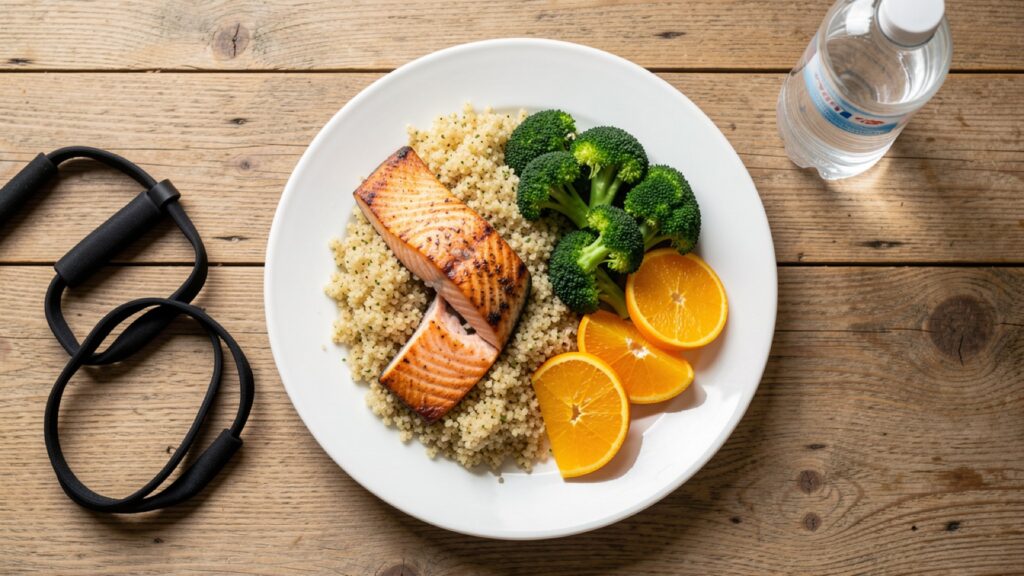
When an injury takes you out of training, eating less to match can feel like common sense. The research is more cautious than that. A 2015 review in Sports Medicine by Tipton says “deficiencies of energy, protein and other nutrients should be avoided,” and that claims for many other nutrients after injury “are rampant, but the evidence is equivocal” (PubMed).
Below is what reviews of the research say about calories, protein and a few vitamins and minerals during recovery, where the evidence is thin, and why supplements call for care.
Please read first: This article is general information, not medical or nutrition advice. It does not diagnose or treat any injury or condition. Talk with your physician or a registered dietitian about what to eat while you recover, especially if you have a medical condition or take medication.
Key Takeaways
– A 2015 review in Sports Medicine says deficiencies of energy, protein and other nutrients should be avoided during injury recovery.
– The same review warns against cutting calories too hard while you are sidelined, and says a large surplus is not the goal either.
– Reviews of injured athletes discuss protein intakes well above the adult RDA of 0.8 g per kilogram of body weight.
– For vitamins and minerals, the research message is to avoid deficiency. Taking more than enough has not been shown to be necessary.
Should you eat less when an injury stops you training?
Probably not as much as you might think, according to a 2015 research review. Tipton’s review notes that “energy expenditure may be increased by 15 % up to 50 %, depending on the type and severity of the injury” (Tipton, full text). Less training lowers total energy use, but “the overall reduction may be less than appears obvious.” If you need crutches, the review adds, the energy cost of getting around rises two- to threefold.
Cutting back too far has costs. According to the review, “if restriction of energy intake is too severe, recovery almost certainly will be slowed,” and negative energy balance “will interfere with wound healing” and “exacerbate muscle loss.” It also says “a large positive energy balance also is undesirable.” The aim it describes is energy balance: enough food to cover what your body is using, without a big surplus.
How much protein does the research suggest during recovery?
More than the bare minimum, though the figures depend on who is being studied. The Recommended Dietary Allowance (RDA) for protein is 0.8 grams per kilogram of body weight per day for healthy adults, according to the NIH Office of Dietary Supplements (ODS, Exercise and Athletic Performance). Newer guidance and research on athletes go higher.
| Source | Protein figure (g per kg of body weight per day) | Who it describes |
|---|---|---|
| RDA, as stated by NIH ODS | 0.8 | Healthy adults |
| Dietary Guidelines for Americans, 2025-2030 | 1.2 to 1.6 | General public, adjusted for calorie needs |
| NIH ODS, citing more recent data | 1.2 to 2.0 | Athletes in training |
| Papadopoulou, Nutrients, 2020 | 2.0 or higher | Energy restriction or sudden inactivity after surgery or injury |
| Tipton, Sports Medicine, 2015 | 2 to 2.5 | Immobilization |
The current Dietary Guidelines for Americans, 2025-2030, set protein serving goals of 1.2 to 1.6 grams of protein per kilogram of body weight per day, “adjusting as needed based on your individual caloric requirements” (Dietary Guidelines for Americans). For injury specifically, Tipton writes that “higher protein intakes (2-2.5 g/kg/day) seem to be warranted during immobilization,” and that at the very least, protein intake should not drop when calories drop. A 2020 review in Nutrients by Papadopoulou says raising protein “to 2.0 g/kg/day or even higher” may help prevent the loss of fat-free mass during energy restriction or sudden inactivity (Papadopoulou, full text).
Those higher numbers come from reviews of research on athletes. They are not a prescription for you. The joint position statement from the American College of Sports Medicine, the Academy of Nutrition and Dietetics and Dietitians of Canada says athletes “should be referred to a registered dietitian/nutritionist for a personalized nutrition plan” (PubMed). That is the sensible route for anyone working out their own number during an injury.
What about carbohydrates and fat?
The evidence is thinner here. Papadopoulou’s review says “the role of CHO in the recovery phase needs further investigation,” and describes the evidence on carbohydrate or fatty acids as limited compared with protein. Its recommendation for injured athletes is “a well-balanced diet that includes adequate amounts of proteins, CHO, antioxidants, and moderate fat.” CHO is shorthand for carbohydrate.
Which vitamins and minerals matter for injury recovery?
Tipton’s review points to several, and its message is about avoiding shortfalls. It notes “a clear association of many micronutrients, such as zinc, vitamin C, vitamin A (and others), with various aspects of wound healing and recovery from injury.” Its conclusion is measured: “deficiencies should be avoided, but supplementation above sufficiency does not appear warranted.”
Vitamin C is a good example. MedlinePlus, from the NIH National Library of Medicine, says vitamin C is used to “form an important protein called collagen, used to make skin, tendons, ligaments, and blood vessels,” and to “heal wounds and form scar tissue” (MedlinePlus, Vitamin C). For bone, Tipton writes that “sufficient calcium and vitamin D during healing from fractures is important for optimal bone formation.” The same review adds that “there is no clear evidence for the necessity of supranormal micronutrient intakes during recovery from injury.”
Here are the NIH Office of Dietary Supplements’ recommended daily amounts for adults:
| Nutrient | Recommended daily amount (adults) |
|---|---|
| Vitamin C | 90 mg for men, 75 mg for women |
| Vitamin D | 15 mcg (600 IU) for ages 19 to 70, 20 mcg (800 IU) for 71 and older |
| Calcium | 1,000 mg for ages 19 to 50 and men 51 to 70, 1,200 mg for women 51 to 70 and everyone 71 and older |
Sources: ODS, Vitamin C, ODS, Vitamin D, ODS, Calcium.
Are supplements worth taking while you recover?
The research calls for caution. Tipton’s review says nutrients such as leucine, omega-3 fatty acids and curcumin “have been demonstrated to be beneficial in rodent studies, but information from studies on injured humans is yet forthcoming.” It adds that “in some situations, higher intakes of these nutrients may do harm,” that there is no information on the optimal dose, and that “caution is warranted.”
More is not always safer. The Office of Dietary Supplements cautions that “getting too much vitamin D can be harmful,” and that high levels “are almost always caused by consuming excessive amounts of vitamin D from dietary supplements.” It lists an upper limit of 100 mcg (4,000 IU) a day for adults (ODS, Vitamin D). For vitamin C, it notes that high doses can cause diarrhea, nausea and abdominal cramps, with an upper limit that ranges from 400 to 2,000 mg depending on age (ODS, Vitamin C for Health Professionals).
Supplements are also regulated differently from medicines. The US Food and Drug Administration says it “does NOT have the authority to approve dietary supplements for safety and effectiveness” before they are sold. The FDA advises talking with “your doctor, nurse, registered dietician, or pharmacist” first, because “some supplements can interact with medications, interfere with lab tests, or have dangerous effects during surgery” (FDA 101: Dietary Supplements).
What should you eat while recovering from an injury?
Mostly, ordinary good eating, kept up while you are less active. In Tipton’s words, this is “the overriding nutritional recommendation for injured exercisers”: a well-balanced diet “based on whole, minimally processed foods.” It also says the diet “should be carefully assessed and changes considered as the injury heals and activity patterns change.”
That last point matters as you return to training. What you eat while you are less active may not fit once you are lifting again. For the training side of coming back from an injury, see lifting safely with past injuries after 40. For what functional nutrition is and how to choose a practitioner, see functional nutrition in Santa Monica.
Frequently Asked Questions
Should I eat less while I am injured?
Not drastically. A 2015 review in Sports Medicine notes that energy use rises during healing and that less training may not cut your needs as much as it seems. The review warns that severe calorie restriction can slow recovery and add to muscle loss, and that a large surplus is not the goal either.
How much protein should I eat after an injury?
The adult RDA is 0.8 grams per kilogram of body weight per day, and the 2025-2030 Dietary Guidelines set a goal of 1.2 to 1.6 grams per kilogram. Reviews of injured athletes discuss 2.0 or more. A registered dietitian can set the right figure for your health and your injury.
Do supplements help an injury heal?
The evidence does not support relying on them. A 2015 review found that supplementing vitamins and minerals above sufficiency does not appear warranted, and that evidence for nutrients like leucine, omega-3s and curcumin comes mainly from rodent studies. The FDA does not approve supplements for safety and effectiveness before sale, so check with a clinician first.
Does vitamin C help with recovery?
Vitamin C is needed to form collagen, which is used to make skin, tendons and ligaments, according to MedlinePlus. Research reviews say to avoid a deficiency, but they have not shown that taking more than enough is necessary. NIH lists 90 mg a day for adult men and 75 mg for adult women.
Nutrition and training support in Santa Monica
If you are in Santa Monica and want to talk about nutrition and training while you recover, alongside your physician’s or dietitian’s advice, you can reach Integrative Training Institute at 310.570.6352 or through the contact page. The studio is at 1358 Michigan Ave, Santa Monica, CA 90404. You can also read the nutrition page.
Sources
- Tipton, Nutritional Support for Exercise-Induced Injuries, Sports Medicine, 2015, retrieved 2026-10-08, https://pubmed.ncbi.nlm.nih.gov/26553492/ (full text: https://pmc.ncbi.nlm.nih.gov/articles/PMC4672013/)
- Papadopoulou, Rehabilitation Nutrition for Injury Recovery of Athletes: The Role of Macronutrient Intake, Nutrients, 2020, retrieved 2026-10-08, https://pubmed.ncbi.nlm.nih.gov/32824034/ (full text: https://pmc.ncbi.nlm.nih.gov/articles/PMC7468744/)
- Thomas, Erdman and Burke, American College of Sports Medicine Joint Position Statement: Nutrition and Athletic Performance, Medicine and Science in Sports and Exercise, 2016, retrieved 2026-10-08, https://pubmed.ncbi.nlm.nih.gov/26891166/
- US Department of Health and Human Services and US Department of Agriculture, Dietary Guidelines for Americans, 2025-2030, retrieved 2026-10-08, https://cdn.realfood.gov/DGA.pdf
- NIH Office of Dietary Supplements, Dietary Supplements for Exercise and Athletic Performance, retrieved 2026-10-08, https://ods.od.nih.gov/factsheets/ExerciseAndAthleticPerformance-HealthProfessional/
- NIH Office of Dietary Supplements, Vitamin C, Vitamin D and Calcium fact sheets, retrieved 2026-10-08, https://ods.od.nih.gov/factsheets/
- NIH National Library of Medicine, MedlinePlus: Vitamin C, retrieved 2026-10-08, https://medlineplus.gov/ency/article/002404.htm
- US Food and Drug Administration, FDA 101: Dietary Supplements, retrieved 2026-10-08, https://www.fda.gov/consumers/consumer-updates/fda-101-dietary-supplements