


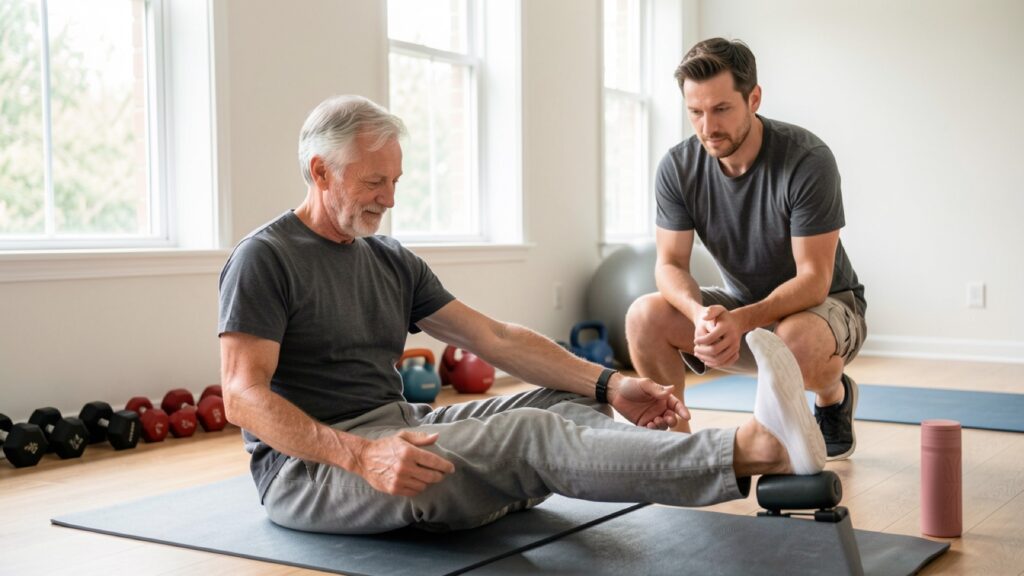
Osteoarthritis (OA) is “the most common type of arthritis,” and it usually shows up in the hands, knees, hips, neck and lower back, according to MedlinePlus from the NIH National Library of Medicine (MedlinePlus, Osteoarthritis). The same page is plain about the outlook: “There is no cure for osteoarthritis. It usually gets worse slowly. But there’s a lot you can do to manage the symptoms.”
Exercise sits at the center of most of that advice. This article covers what the major guidelines say about exercise and strength training for knee OA, what the best current review found, how pain fits in, and why a clinician should shape the plan.
Please read first: This article is general information, not medical advice. It does not diagnose osteoarthritis or tell you which exercise is right for you. If you have knee pain or have been diagnosed with osteoarthritis, talk with your physician or physical therapist before you start or change a training program.
Key Takeaways
– The 2019 American College of Rheumatology and Arthritis Foundation guideline strongly recommends a regular, ongoing exercise program for knee OA.
– Guidelines treat strengthening as one good option among several, alongside walking, neuromuscular training and aquatic exercise, with no ranking.
– A 2024 Cochrane review found exercise probably improves pain and function in the short term, by amounts of uncertain clinical importance.
– HHS says that when done safely, physical activity does not make osteoarthritis or its pain worse, and your clinician should help match the plan to you.
What is knee osteoarthritis, and who diagnoses it?
Knee OA is a joint condition that a clinician diagnoses, not something to self-diagnose from symptoms. NIH’s National Institute of Arthritis and Musculoskeletal and Skin Diseases (NIAMS) says “there is no single test for osteoarthritis.” Diagnosis can include giving a doctor your medical history and “having a physical exam to check your general health, reflexes, and problem joints” (NIAMS, Osteoarthritis).
The CDC suggests seeing a rheumatologist, a provider who specializes in arthritis, who may use “a physical exam,” “X-rays,” “lab tests” and “a review of your health history” (CDC, Osteoarthritis). In the UK, the National Institute for Health and Care Excellence (NICE) tells clinicians they can diagnose OA without imaging in people 45 or over with activity-related joint pain and little or no morning stiffness (NICE NG226). The routes differ, but each runs through a clinician.
Do the guidelines recommend exercise for knee osteoarthritis?
Yes, consistently. The 2019 American College of Rheumatology (ACR) and Arthritis Foundation guideline states that “exercise is strongly recommended for patients with knee, hip, and/or hand OA,” and that its panel “made strong recommendations for patients to participate in a regular, ongoing exercise program” (ACR/Arthritis Foundation guideline, full text).
The Osteoarthritis Research Society International (OARSI) 2019 guidelines list “arthritis education and structured land-based exercise programs with or without dietary weight management” as core treatments for knee OA (PubMed). NICE’s UK guidance says to offer everyone with OA “therapeutic exercise tailored to their needs (for example, local muscle strengthening, general aerobic fitness).”
The US Physical Activity Guidelines for Americans add that “strong scientific evidence indicates that both aerobic activity and muscle-strengthening activity provide therapeutic benefits” for people with osteoarthritis (HHS, Physical Activity Guidelines).
Is strength training better than other exercise for knee OA?
Not according to the evidence so far. The ACR guideline says “current evidence is insufficient to recommend specific exercise prescriptions,” and that exercise for knee and hip OA “could include walking, strengthening, neuromuscular training, and aquatic exercise, with no hierarchy of one over another.” The 2024 Cochrane review likewise “did not find any differences in effects between different types of exercise” (PubMed).
So strength training is a reasonable choice, not the only one. When it is part of the plan, the guidance is practical. NIAMS describes “strengthening exercises performed with weights or exercise bands to strengthen muscles that support joints affected by arthritis.” The CDC advises choosing “weights or resistance bands that do not cause joint pain” and increasing “the difficulty in small amounts over time” (CDC, Arthritis and Physical Activity). The American Academy of Orthopaedic Surgeons adds that specific exercises can “help strengthen the muscles in your leg” (OrthoInfo, Arthritis of the Knee).
For the general principles of training around a joint history, see our article on lifting safely with past injuries after 40.
How much does exercise help knee osteoarthritis?
Some, on average, though how much that matters is uncertain. The 2024 Cochrane review pooled 139 trials with 12,468 participants. It found “low- to moderate-certainty evidence that exercise probably results in an improvement in pain, physical function, and quality of life in the short-term.” It then added that, “based on the thresholds for minimal important differences that we used, these benefits were of uncertain clinical importance” (PubMed).
The numbers show why. Compared with no treatment or usual care, exercise improved pain by about 13 points and physical function by about 12.5 points on 0 to 100 scales, right after the program. The authors measured those against minimal important differences of 12 points for pain and 13 for function, so the averages sit close to the line. An earlier 2015 Cochrane review had reported “high-quality evidence” of short-term pain relief (PubMed); the 2024 update, with many more trials, is more cautious.
Averages hide a lot of individual variation, which is one reason the guidelines keep pointing back to a plan built with your clinician.
Will exercise make knee arthritis pain worse?
The guidance says safe activity should not, though NICE notes that pain may increase at first. HHS states: “When done safely, physical activity does not make the disease or the pain worse.” NICE’s UK guidance tells clinicians to explain “that joint pain may increase when they start therapeutic exercise,” and that “doing regular and consistent exercise, even though this may initially cause pain or discomfort, will be beneficial for their joints.”
There is no simple pain rule to apply on your own. The ACR guideline notes “there is no uniformly accepted level of pain at which a patient should or should not exercise,” and recommends “shared decision-making between the treating clinician and the patient regarding when to initiate an exercise program.” The 2024 Cochrane review rated the evidence on harms as low-certainty and mixed. The CDC says to contact your health care provider “if pain or other symptoms are severe,” and any pain you are unsure about is worth raising with them too.
How much activity do the guidelines suggest?
HHS gives a target for adults with chronic conditions who are able: “at least 150 minutes (2 hours and 30 minutes) to 300 minutes (5 hours) a week of moderate-intensity” aerobic activity, plus “muscle-strengthening activities of moderate or greater intensity and that involve all major muscle groups on 2 or more days a week.”
The same guidelines add two qualifiers. “People with osteoarthritis should match the type and amount of physical activity to their abilities and the severity of their condition.” And “adults with chronic conditions or symptoms should be under the care of a health care provider.” The weekly target is something to build toward with guidance, not where to start.
Who should guide a strength training plan for knee OA?
Your clinician, with a coach working inside their advice. The National Institute on Aging says to “always talk with your doctor before starting a new exercise program” and to “start slowly” (NIA, Osteoarthritis). The CDC says people with arthritis “may benefit from seeing a physical therapist when beginning physical activity,” and the American Academy of Orthopaedic Surgeons notes that “your doctor or a physical therapist can help develop an individualized exercise program” (OrthoInfo, Arthritis of the Knee).
Supervision is where the sources differ a little. The ACR guideline says exercise programs “are more effective if supervised, often by physical therapists,” while the 2024 Cochrane review found no relationship between results and the ratio of real-time consultations with a provider between the exercise and comparison groups. Either way, a coach’s job is narrow: build sessions inside the limits your clinician sets, progress load gradually, and adjust when you report pain. Our guides to strength training for women over 40 and strength training for men over 40 cover the training side for general audiences.
Frequently Asked Questions
Is strength training safe with knee osteoarthritis?
HHS says that when done safely, physical activity does not make osteoarthritis or its pain worse, and that strong evidence supports muscle-strengthening activity for people with OA. Safety depends on your condition and the plan, so talk with your physician or physical therapist before starting, and start slowly.
What type of exercise is best for knee osteoarthritis?
No single type has been shown to be best. The ACR and Arthritis Foundation guideline lists walking, strengthening, neuromuscular training and aquatic exercise “with no hierarchy of one over another,” and a 2024 Cochrane review found no differences in effect between exercise types. Choose with your clinician based on what you can do consistently.
How often should I strength train with knee arthritis?
For adults with chronic conditions who are able, HHS suggests muscle-strengthening activity on 2 or more days a week, alongside aerobic activity. It also says people with osteoarthritis should match the type and amount to their abilities and the severity of their condition, under a health care provider’s care.
Can exercise cure knee osteoarthritis?
No. MedlinePlus states that there is no cure for osteoarthritis and that it usually gets worse slowly, though there is a lot people can do to manage symptoms. A 2024 Cochrane review found exercise probably improves pain and function in the short term, by amounts of uncertain clinical importance.
Strength training in Santa Monica
If you are in Santa Monica and want to talk about strength training with knee osteoarthritis, once your physician or physical therapist has weighed in, you can reach Integrative Training Institute at 310.570.6352 or through the contact page. The studio is at 1358 Michigan Ave, Santa Monica, CA 90404. You can also read the personal training page.
Sources
- NIH National Library of Medicine, MedlinePlus: Osteoarthritis, retrieved 2026-10-08, https://medlineplus.gov/osteoarthritis.html
- NIH National Institute of Arthritis and Musculoskeletal and Skin Diseases, Osteoarthritis: Diagnosis, Treatment, and Steps to Take, retrieved 2026-10-08, https://www.niams.nih.gov/health-topics/osteoarthritis/diagnosis-treatment-and-steps-to-take
- Centers for Disease Control and Prevention, Osteoarthritis, retrieved 2026-10-08, https://www.cdc.gov/arthritis/osteoarthritis/index.html
- Centers for Disease Control and Prevention, Arthritis: physical activity, retrieved 2026-10-08, https://www.cdc.gov/arthritis/prevention/index.html
- Kolasinski et al., 2019 American College of Rheumatology/Arthritis Foundation Guideline for the Management of Osteoarthritis of the Hand, Hip, and Knee, Arthritis Care & Research, 2020, retrieved 2026-10-08, https://pmc.ncbi.nlm.nih.gov/articles/PMC11488261/
- Bannuru et al., OARSI guidelines for the non-surgical management of knee, hip, and polyarticular osteoarthritis, Osteoarthritis and Cartilage, 2019, retrieved 2026-10-08, https://pubmed.ncbi.nlm.nih.gov/31278997/
- Lawford et al., Exercise for osteoarthritis of the knee, Cochrane Database of Systematic Reviews, 2024, retrieved 2026-10-08, https://pubmed.ncbi.nlm.nih.gov/39625083/
- Fransen et al., Exercise for osteoarthritis of the knee, Cochrane Database of Systematic Reviews, 2015, retrieved 2026-10-08, https://pubmed.ncbi.nlm.nih.gov/25569281/
- National Institute for Health and Care Excellence (UK), Osteoarthritis in over 16s: diagnosis and management (NG226), retrieved 2026-10-08, https://www.nice.org.uk/guidance/ng226/chapter/Recommendations
- US Department of Health and Human Services, Physical Activity Guidelines for Americans, 2nd edition, retrieved 2026-10-08, https://odphp.health.gov/sites/default/files/2019-09/Physical_Activity_Guidelines_2nd_edition.pdf
- National Institute on Aging, Osteoarthritis, retrieved 2026-10-08, https://www.nia.nih.gov/health/osteoarthritis/osteoarthritis
- American Academy of Orthopaedic Surgeons, OrthoInfo: Arthritis of the Knee, retrieved 2026-10-08, https://www.orthoinfo.org/diseases–conditions/arthritis-of-the-knee/